
OSHA Safety on Florida Construction Sites: Why It Matters to Homeowners

A beautiful renovation begins long before the finishes go in. It begins with an organized site, qualified people and a plan for controlling the hazards created by demolition, framing, electrical work, elevated work, silica-producing tasks and Florida heat.
The short answer
For most private-sector construction employers and workers in Florida, workplace safety falls under federal OSHA. OSHA requirements are primarily employer obligations: contractors and subcontractors must evaluate hazards, train workers and use appropriate controls. Homeowners do not administer OSHA programs, but they benefit when the people managing their project treat safety as part of professional construction—not as an afterthought.
What OSHA does—and what it does not do
The Occupational Safety and Health Administration establishes and enforces workplace safety and health standards, provides compliance assistance and protects workers’ rights. Florida does not operate an OSHA-approved state plan for private-sector workplaces, so federal OSHA offices cover most private-sector employers and employees in the state.
OSHA is not the same thing as a local building department. Building officials review permitted work for compliance with applicable construction codes, while OSHA addresses employee safety and health. A project can require both workplace-safety controls and municipal or county inspections. That distinction is one reason our permit and inspection coordination is planned as its own part of the construction process.
Why construction safety matters to a homeowner
OSHA standards are designed to protect workers, yet the effects of good safety planning reach beyond the crew. A controlled work zone helps reduce preventable injuries, property damage, disrupted schedules, uncontrolled dust and unsafe access through an occupied home. It also encourages trades to communicate before one task creates a hazard for the next.
The larger and more interconnected the renovation, the more important that coordination becomes. A design-build whole-home renovation may involve demolition, framing, electrical, plumbing, HVAC, cabinetry, stone, flooring and finish work. Each phase changes the site, and each trade must understand where it can work safely and what conditions it is leaving behind.
Common hazards on Florida residential construction sites
OSHA describes construction as a high-hazard industry. The correct control depends on the task, the site and the workers involved, but several categories appear repeatedly on residential construction and remodeling projects.
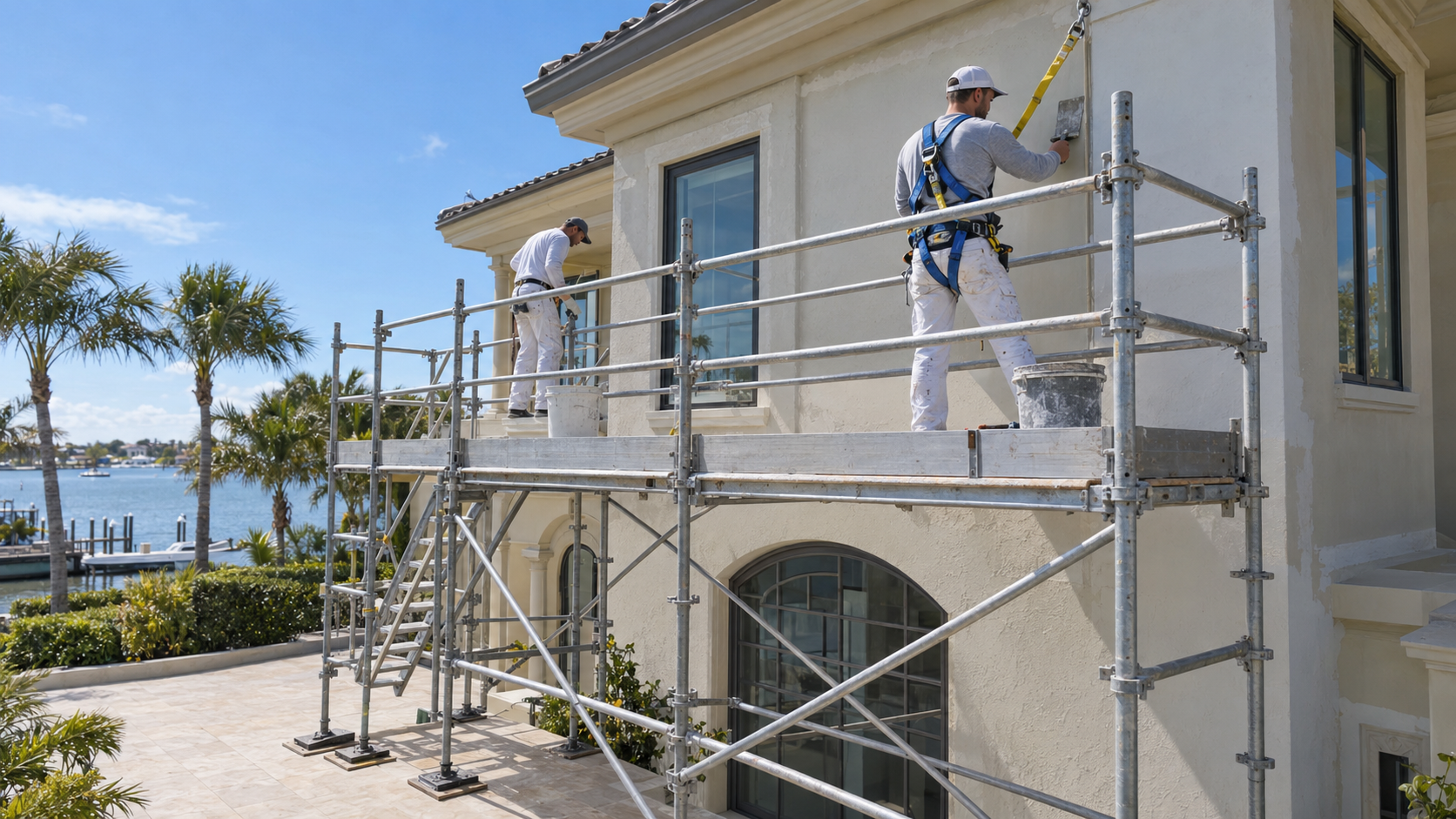
Falls and elevated work
Open edges, roofs, scaffolds, ladders and floor openings require careful planning. Guardrails, properly erected scaffolds, suitable access and fall-arrest systems must be selected and used according to the actual conditions.
Electrical hazards
Temporary power, extension cords, energized equipment and exposed circuits can create serious risks. Electrical work should be performed by appropriately qualified tradespeople with suitable protection and work practices.
Silica, dust and airborne contaminants
Cutting concrete, masonry, tile and stone can release respirable crystalline silica. Engineering controls such as wet cutting, local dust collection and HEPA filtration may be necessary depending on the task and exposure.
Struck-by and caught-between hazards
Moving materials, power tools, vehicles, unstable loads and active demolition can injure workers or bystanders. Controlled access and deliberate material handling are essential.
Personal protective equipment
Eye, hearing, hand, foot, head and respiratory protection should match the hazard. PPE is not decoration, and more equipment is not automatically safer when it is unrelated to the work.
Heat exposure
Florida heat can affect exterior crews and people working in unconditioned structures. Water, rest, shade, acclimatization and recognition of heat-illness symptoms all deserve advance attention.
Fall protection deserves special attention
Falls remain one of construction’s most serious hazards. Safe elevated work is not achieved by simply handing someone a harness. The entire system matters: the walking surface, scaffold or ladder, guardrails, anchor point, connecting equipment, clearance and worker training all have to make sense together.
This becomes especially relevant during roof work, exterior repairs and additions, as well as structural modifications that temporarily create floor openings or exposed edges. The site conditions must be reassessed as framing is removed, replaced or reconfigured.
What professional safety coordination looks like
A safe-looking photograph does not prove that a company has an effective safety program. The more meaningful signs appear in day-to-day behavior: the site is organized, access is controlled, the people performing the work understand their tasks, and unsafe conditions are corrected instead of ignored.
- Work is planned before demolition or installation begins.
- Contractors identify who controls each work area and who is responsible for each crew.
- Employees receive task-appropriate instruction and required training.
- Tools, ladders, scaffolds and temporary electrical equipment are inspected and used correctly.
- Walkways, exits and work zones remain reasonably clear.
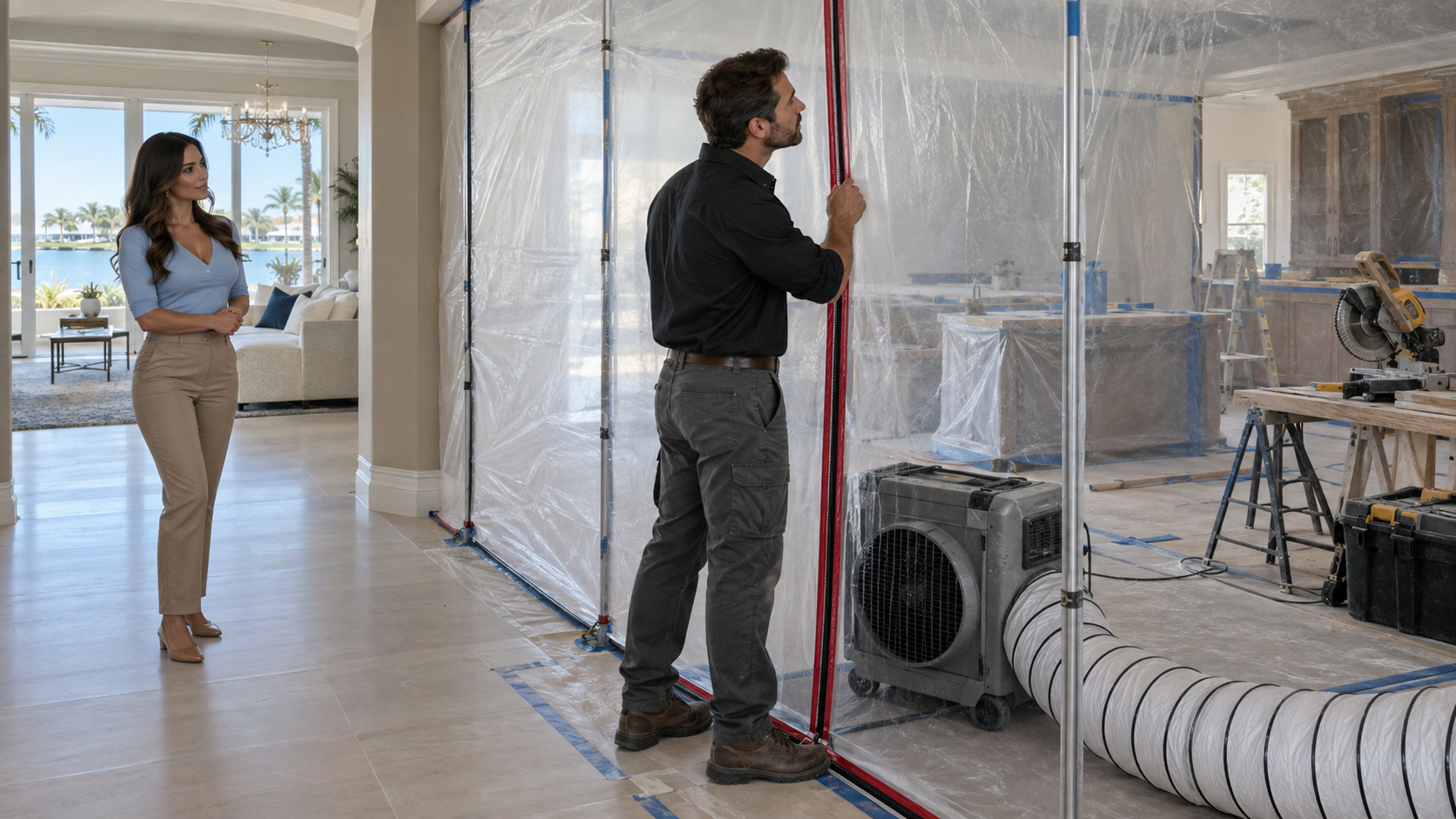
- Dust, debris and hazardous products are controlled instead of allowed to spread through the home.
- Homeowners, children, pets and visitors are kept out of active construction areas.
- Changing conditions are discussed with affected trades before work resumes.
That same discipline supports quality. During a luxury kitchen renovation, for example, safe sequencing helps prevent electricians, plumbers, cabinetry installers and stone fabricators from competing for the same workspace. In a bathroom renovation, controlled demolition and clean access can protect the occupied portions of the home while waterproofing, plumbing and finish work progress.
What homeowners should ask before work begins
You do not need to become the project’s safety manager. You should, however, expect clear answers about who is responsible for the site and how the contractor intends to protect workers, occupants and the property.
- Who supervises the jobsite? There should be a clear line of responsibility.
- How will occupied areas be separated? Ask about barriers, access routes, floor protection, dust control and daily cleanup.
- How are subcontractors qualified? Licensing and insurance requirements vary by trade and scope, but documentation should not be an afterthought. Homeowners can also review how MDI evaluates subcontractor licensing and insurance.
- What work requires permits and inspections? Permits are separate from OSHA obligations, but both depend on planning and accountability.
- What should we do while work is active? Confirm entry restrictions, pet and child safety, parking, deliveries and emergency contacts.
For complex work, hiring a properly credentialed contractor is an important starting point. MDI Custom Homes operates as a Florida Certified Building Contractor, license CBC1267559, and provides coordinated remodeling and construction services throughout Pinellas County. That credential is different from OSHA training, trade licensing or municipal inspection approval; each serves a distinct purpose.
Safety also depends on communication
Construction leaders routinely move between active work areas, homeowners, inspectors, suppliers and specialty trades. Calls cannot always be answered safely while someone is climbing, operating equipment or concentrating on a field decision. That practical reality is one reason MDI supports AnswerCraft for contractors: the service at AnswerCraftAI.com gives missed callers a professional starting point without encouraging a field supervisor to divide attention during active work.
Technology does not replace training, supervision or jobsite controls. Used appropriately, it can support the communication systems surrounding the work while the people on site stay focused on the task in front of them.
OSHA safety questions homeowners frequently ask
Does Florida have its own OSHA program?
No. Florida does not have an OSHA-approved State Plan covering private-sector employment. Federal OSHA covers most private-sector employers and workers in Florida through its area offices.
Does OSHA inspect every construction project?
No. OSHA does not inspect every jobsite. Inspections may arise from imminent-danger situations, severe injuries or fatalities, worker complaints or referrals, targeted programs and follow-up activity. Employers remain responsible for applicable requirements whether an inspector visits or not.
Is an OSHA inspection the same as a building inspection?
No. OSHA inspections concern workplace safety and health. Building inspections concern permitted construction and applicable codes. One does not replace the other.
Can a contractor call itself OSHA certified?
OSHA does not certify contractors. Workers and supervisors may complete OSHA Outreach Training courses, commonly called OSHA 10 or OSHA 30, but OSHA states that these are voluntary training programs and are not certifications.
Should homeowners enter an active work area?
Only when the contractor confirms that entry is appropriate and explains the route and any necessary precautions. Children, pets and visitors should remain outside controlled work zones.
Where can workers find official OSHA information?
Workers and employers can use the official OSHA construction resources and the federal OSHA offices serving Florida. Workers may also contact OSHA about hazards or retaliation rights.
The bottom line
Safety is not a single checklist, a hard hat in a photograph or a claim made on a website. It is a continuing process of recognizing hazards, selecting appropriate controls, coordinating qualified people and responding when site conditions change. For homeowners, that discipline is one of the clearest signs that a renovation is being managed professionally.
Planning a renovation in Pinellas County?
Talk with MDI Custom Homes about your project, permitting needs, construction scope and the coordination required to carry the work from planning through final inspection.
Request a ConsultationThis article provides general educational information and is not legal, regulatory or site-specific safety advice. OSHA requirements depend on the employer, work activity and conditions. Contractors and employers should consult current OSHA standards and qualified safety professionals when necessary.
