
Natural wood cabinetry can bring warmth and character to a kitchen, bathroom or built-in storage wall. But the phrase “real wood” is only the beginning of a useful product description. For a Pinellas Park, Seminole or Largo remodel, ask what is used in each cabinet component, how it is finished and how the assembled system suits the room.
Updated October 15, 2026 · MDI Custom Homes LLC · Florida Certified Building Contractor CBC1267559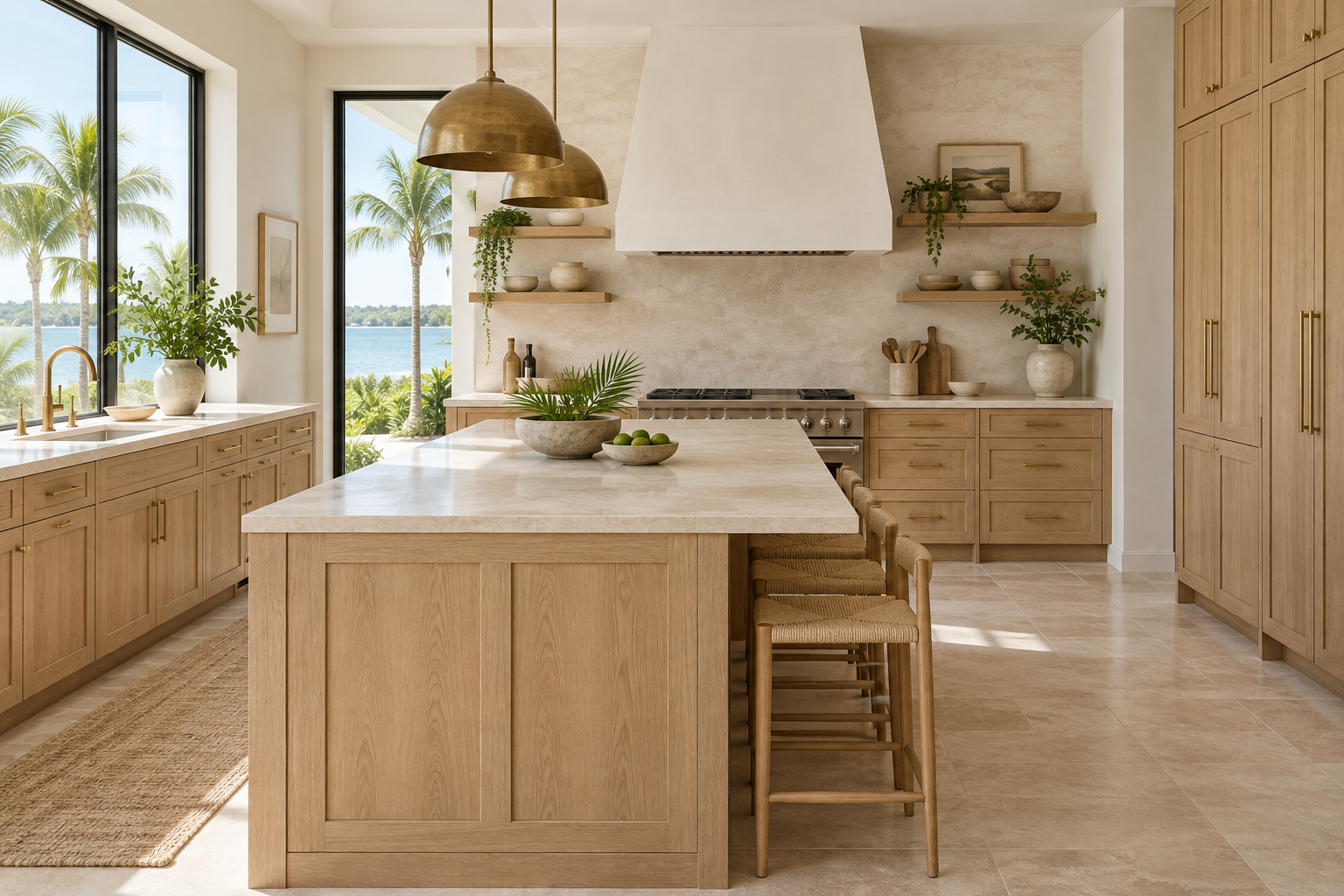
1. Learn the material terms before comparing cabinets
| Term | What it describes | What to ask |
|---|---|---|
| Solid wood | Wood pieces used for a particular component, sometimes joined into a wider assembly | Which components and species are specified? |
| Wood veneer | A thin layer of wood bonded to a supporting substrate | What is the substrate, how are edges finished and what is the care guidance? |
| Plywood | A panel made from bonded layers of wood veneer | What thickness, core and construction are specified for the cabinet part? |
| MDF | Medium-density fiberboard, an engineered panel made from wood fibers and a binder | Where is it used and what finish and moisture limitations apply? |
| Particleboard | An engineered panel made from wood particles and a binder | What grade, facing, edge treatment and application are specified? |
| Laminate or other decorative facing | A surface layer over a supporting material | What is the full assembly beneath the appearance? |
A wood-look surface is not necessarily wood veneer, and veneer is not the same as solid wood. Ask the supplier to identify the surface and substrate clearly. Material names should help explain the product, not replace the rest of the specification.
2. Ask what is in each cabinet component
Review the cabinet box sides, top or stretchers, bottom, back and shelves. Then review the face frame if present, the doors and drawer fronts, and the drawer boxes. A cabinet system can use different materials in different locations for a reason.
- Doors: distinguish the frame from the center panel and confirm the finish on both sides.
- Box and back: review the stated construction and installation requirements.
- Shelves: check thickness, support method, useful span and stated load limits.
- Drawers: check box construction, bottom, slide specification and usable interior space.
- Exposed ends: identify whether the visible finish requires a separate panel or other finishing piece.
Do not infer the entire cabinet specification from a sample door. Our quality cabinetry planning guide explains how component choices connect to storage, fit and installation.
3. Review grain, color and finish as separate decisions
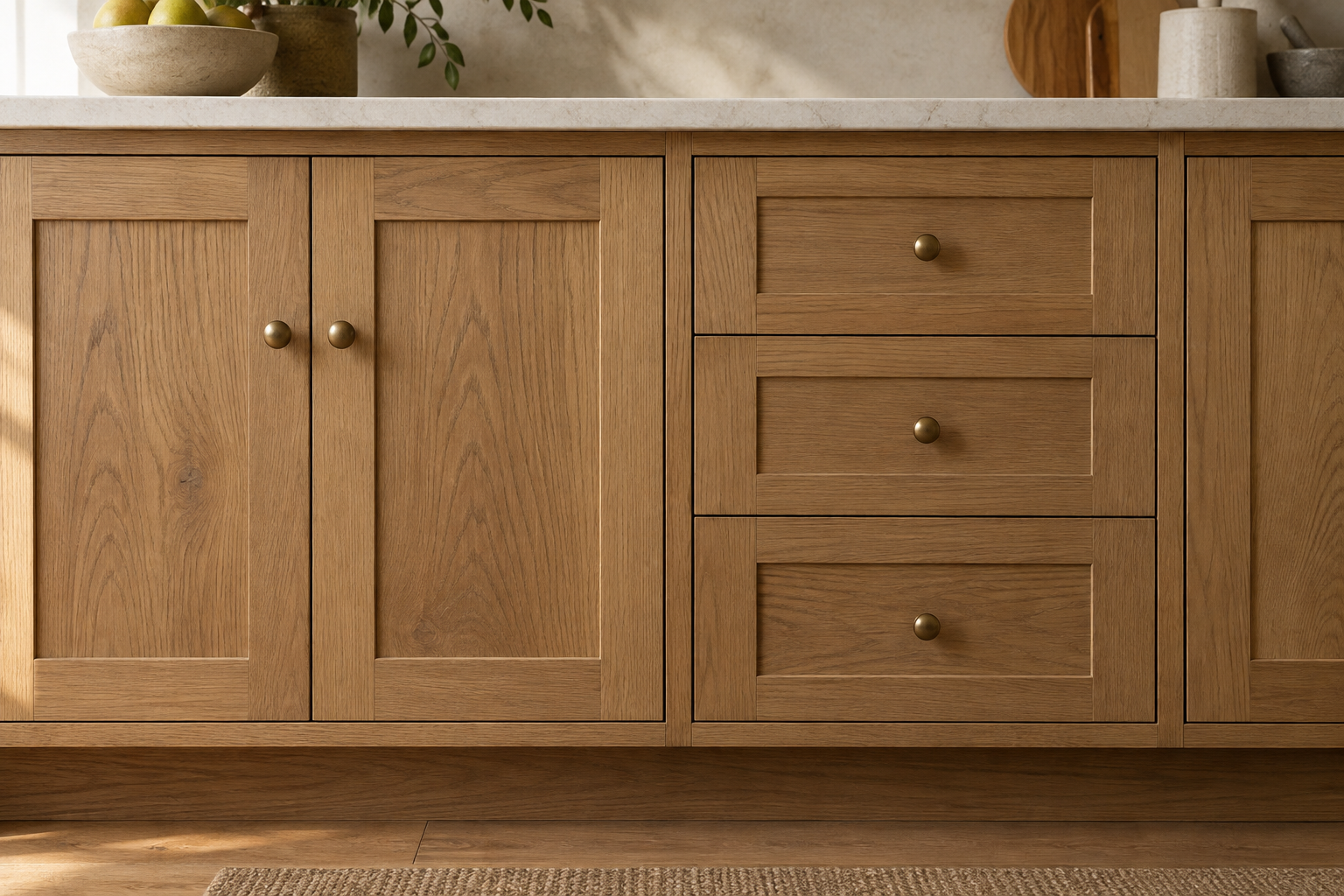
Wood species, grain pattern and finish all affect appearance. A clear or stained finish reveals different characteristics than a painted finish. Ask whether the sample is representative of the expected range across a complete order.
Look at samples beside the intended counter, flooring and backsplash under the room’s lighting. Review the door profile, edge detail and sheen as well as the color. A small sample is useful for comparison, but it cannot show every natural grain variation or how a full wall of cabinets will appear.
Discuss the visible relationship between doors, drawer fronts, fillers and end panels. A well-resolved design treats those transitions as part of the cabinet package. See our cabinet quote comparison guide for the pieces to include in an order review.
4. Plan for moisture without assuming wood is waterproof
Wood responds to moisture conditions. The USDA Forest Products Laboratory’s Wood Handbook explains moisture relations, dimensional change and moisture control during storage and construction. A cabinet’s design, finish and installation must account for its intended environment.
Follow the manufacturer’s guidance for storage, indoor conditions and installation. Do not leave cabinetry exposed to weather or treat an unfinished jobsite as equivalent to a conditioned interior. Ask the supplier what conditions the selected product requires before delivery.
In kitchens and bathrooms, coordinate plumbing and address leaks or recurring moisture promptly. Neither a wood label nor a premium finish makes a cabinet immune to water damage. Do not assume a cabinet is suitable for an exterior kitchen or direct wet-area exposure unless the product is specifically intended for that use.
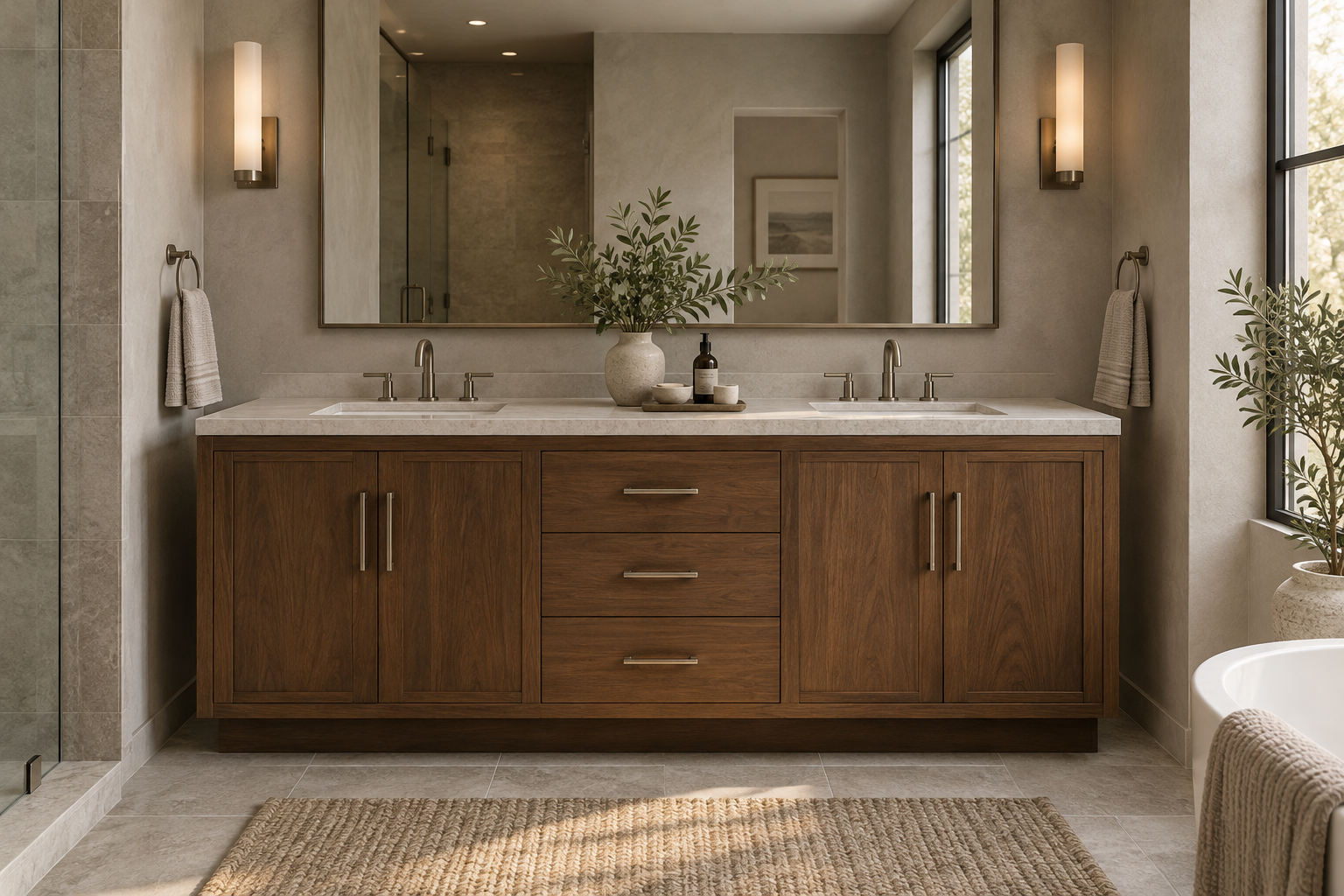
For vanity planning, see our bathroom remodeling services and custom bathroom planning ideas.
5. Evaluate the complete assembly and hardware
Material choice is one part of cabinet performance. Joinery, panel construction, shelf support, hardware, finish and installation also matter. A material label alone cannot establish how two complete cabinet systems compare.
Operate a sample door and drawer if possible. Review adjustment, drawer extension, stated load limits and the availability of service parts. Ask whether the proposed accessories fit the actual interior dimensions rather than only the outside cabinet width.
RTA means ready to assemble; it is not a universal quality rating. Likewise, a custom-built cabinet needs a clear specification, and a manufactured cabinet can still be used in a carefully tailored room design. Compare the selected products and the work needed to install them.
Our cabinet buying checklist provides additional questions about hardware, measurements and ordering.
6. Ask for specific product and emissions documentation
For covered composite-wood products, ask for the applicable TSCA Title VI compliance information. The EPA’s consumer guidance explains that hardwood plywood, MDF and particleboard are covered product types and describes labeling requirements.
An emissions-compliance statement addresses a specific requirement. It is not a promise of zero emissions, waterproof construction or superior durability in every application. Ask the supplier to support broader environmental or performance claims with documentation that applies to the exact product.
Keep the cabinet line, finish name, order documents, care instructions and warranty information together. If the seller claims a certification, confirm its scope rather than assuming it covers every product in the showroom.
7. Follow the finish system’s care instructions
Use the cabinet manufacturer’s cleaning instructions and approved products. Address spills promptly and avoid leaving wet cloths or standing moisture against doors, drawer fronts or cabinet interiors. Pay particular attention around sinks, dishwashers and frequently used vanity areas.
Do not apply an extra sealer, polish or coating simply because the cabinet contains wood. A factory finish may require a specific care approach, and an unapproved treatment can change its appearance or affect warranty coverage. Ask before attempting repairs or refinishing.
When a door rubs or a drawer stops operating normally, investigate the cause rather than repeatedly forcing it. Hardware adjustment, loading, installation conditions or a moisture problem may need attention. Keep access to plumbing and serviceable equipment clear.
At the final walkthrough, record unresolved finish or operation items and agree on the next step. Our project closeout resource explains how to finish that process clearly.
8. Choose the cabinetry for the way the room will be used
Prioritize useful storage, appropriate materials, a coherent finish palette and a layout that works with the actual appliances and circulation. Natural wood may be part of that solution, but the goal is a complete room that functions well.
For a kitchen, plan cookware and pantry storage before selecting organizers. For a bathroom, coordinate sink bowls, plumbing and daily-use items with the vanity interior. For a built-in office or media wall, include cable routes, equipment ventilation and service access.
No cabinet material can guarantee a particular resale price or faster home sale. Evaluate the renovation against your needs and the property as a whole, with a clear scope and realistic expectations. For layout help, see small-kitchen planning and interior reconfiguration.
Plan wood cabinetry as part of a coordinated renovation
Explore MDI Luxury Cabinetry’s current cabinetry options and request the specifications for the selected line. Confirm the material, finish, sizing and installation responsibilities for your exact project rather than relying on a general collection description.
MDI Custom Homes focuses on high-end kitchen remodeling, custom bathrooms, interior reconfigurations and whole-home renovations in Pinellas County. For a project in Pinellas Park, Seminole, Largo or a nearby community, discuss the cabinetry and surrounding remodeling scope with MDI Custom Homes.
Bring room photos, a short list of storage needs and the finishes you are considering. The most useful starting point is understanding the room before committing to a cabinet label.
Wood cabinetry questions, answered
Does real wood cabinetry mean every part is solid wood?
No. A cabinet can combine solid wood, veneer, plywood and other engineered wood products. Ask which material is used for each component.
Is wood veneer the same as a printed wood-look surface?
No. Wood veneer is a thin layer of wood bonded to a substrate. A printed decorative surface is a different material. Ask for the surface and substrate specification.
Is plywood cabinetry waterproof?
A plywood description alone does not establish waterproof performance. Follow the selected product’s intended-use, moisture and care instructions, and address leaks promptly.
Will every natural wood door match the sample exactly?
A small sample cannot represent every grain and color variation. Discuss the expected range and review representative samples under the planned lighting.
Does RTA describe the cabinet material?
No. RTA means ready to assemble. The actual materials, hardware, finish and assembly requirements must be checked in the product specification.
Should wood cabinets receive an extra protective sealer?
Only if the cabinet manufacturer specifically permits or recommends it for that finish. Follow the approved cleaning and care instructions rather than adding an unapproved coating.
Bring your project into focus.
Tell MDI Custom Homes what you want to improve, what you want to keep and what matters most. We can discuss the scope and next planning steps for your Pinellas County home.
Discuss your renovation ↗Call 727-213-7309Official resources
- USDA Forest Products Laboratory: Wood Handbook
- EPA: consumer guidance on composite-wood standards
- MDI Luxury Cabinetry: cabinetry options
Use the current official guidance and project-specific requirements when planning the work.
Design imagery is illustrative and does not depict completed MDI projects or exact manufacturer products.
