Kitchen material selection is a series of connected decisions. A countertop affects sink details and cabinet support; flooring affects finished heights; a backsplash changes how outlets, trim and lighting come together. This guide compares the main choices for Pinellas County kitchens and explains what to confirm before the products are ordered.
Updated October 16, 2026 · MDI Custom Homes LLC · Florida Certified Building Contractor CBC1267559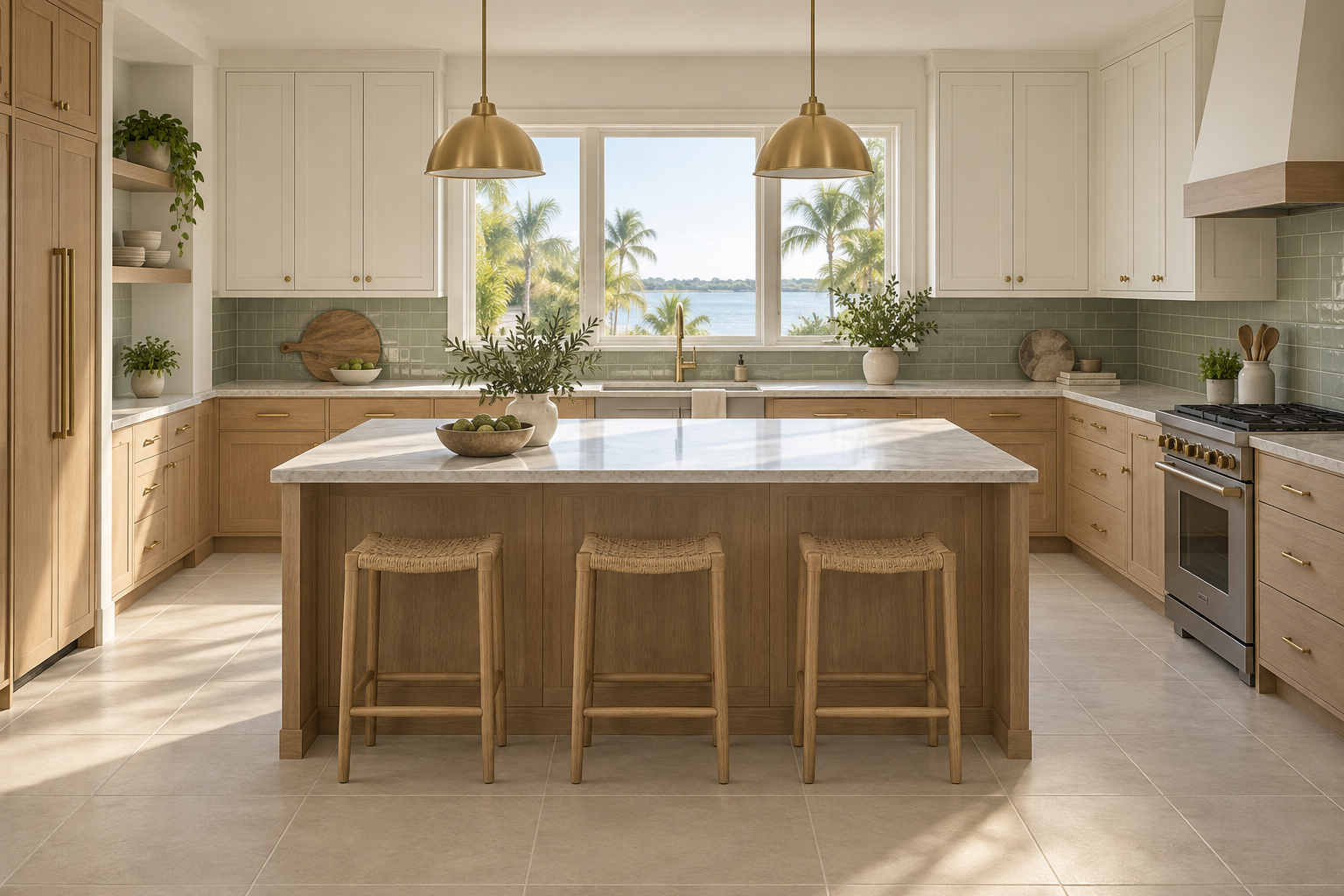
Start with use, care and the parts of the kitchen you will keep
List how the room is used: frequent cooking, baking, entertaining, children, pets or part-time occupancy. Then identify the maintenance you are willing to perform. A material that fits your habits is more useful than a finish chosen only because it looks impressive in a photograph.
Record retained appliances, cabinetry, windows and adjacent flooring. Collect dimensions and model information before committing to replacements. If the layout also needs work, begin with our kitchen remodeling resource and Clearwater Beach kitchen planning guide.
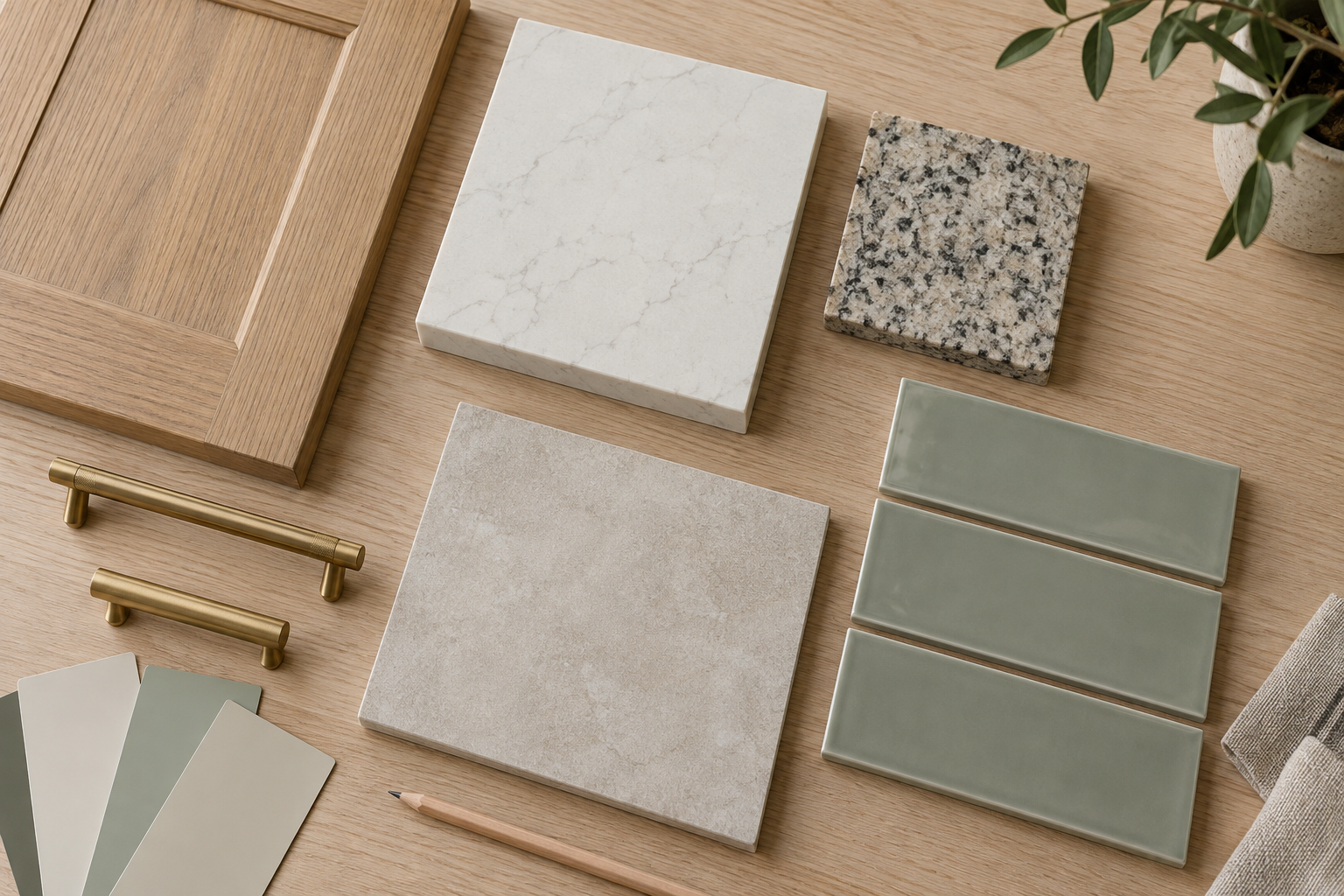
Compare countertop materials by their tradeoffs
Ask to see the actual slab or a representative range of samples, along with edge, seam and finish options. A small sample cannot show every variation in a large surface. Confirm sink cutouts, support, delivery access and who will template and install the top.
| Material | Why consider it? | What to confirm |
|---|---|---|
| Engineered quartz | A wide choice of patterns with straightforward routine care. | Heat protection, approved cleaners, edge details and brand-specific care requirements. |
| Granite and other natural stone | Distinct natural variation and the character of a selected slab. | Stone identification, finish, sealing advice, slab layout and fabrication details. |
| Marble | Natural veining and a surface that can develop a lived-in patina. | Acceptance of acid etching and the care or restoration the chosen finish may need. |
| Porcelain or sintered surfaces | Large-format patterns and a range of surface finishes. | The exact product’s countertop suitability, thickness, edge treatment, support and fabrication requirements. |
| Solid surface or laminate | Additional options for coordinating appearance and project budget. | Product limits, seams, heat precautions, sink compatibility and repair options. |
As one product example, Cambria’s quartz care guidance states that its surfaces do not require sealing and recommends protection from hot cookware. Apply the instructions for the product you actually select; “quartz” does not mean heat-proof.
Separate staining, etching and sealing when choosing stone
A stain and an etched finish are different problems. Acidic substances can alter the finish of acid-sensitive stone, including many marbles. A surface may therefore show a dull mark even when no stain remains.
The Natural Stone Institute’s care guide explains that sealing can improve stain resistance but does not make stone stain-proof, and many stones may not need sealing. Ask the supplier for guidance on the actual stone and finish instead of assuming every granite countertop needs the same recurring treatment.
Before ordering, request written care instructions and discuss what ordinary wear will look like. Choose a finish whose likely appearance over time you can live with.
Evaluate cabinet construction beyond the door material
A cabinet is an assembly. Door frames, center panels, box sides, shelves, backs, drawer boxes and exposed end panels may use different materials. “Wood cabinets” is not a complete specification, and a solid-wood door does not establish the construction of the box behind it.
- Wood and wood veneer: review grain, color variation, finish samples and how exposed panels will match.
- Painted components: ask which substrates are used and how joints, edges and touch-up are handled.
- Laminate or other surfaced panels: inspect edges, seams, available matching parts and the manufacturer’s care limits.
- Hardware: identify hinges, slides, adjustment provisions and stated load limits for the selected components.
Ask for construction details and any verified product certifications. KCMA’s quality certification program describes testing of cabinet structure, doors, drawers and finishes; verify whether the specific product carries a certification rather than assuming it from the material name.
For a closer comparison, read our cabinet quality guide and wood cabinet materials guide. You can also explore MDI Luxury Cabinetry’s current collections; confirm the specifications of the collection being quoted.
Choose flooring as an installed system
Compare how each floor feels underfoot, how it meets adjoining rooms and what the installation requires. Review substrate condition, moisture testing where required, finished height, appliance removal clearance and transitions before choosing the final product.
| Floor option | Planning question |
|---|---|
| Ceramic or porcelain tile | Is the tile appropriate for this floor, and how will substrate preparation, movement joints, grout and transitions be handled? |
| Wood flooring | Does the product suit the installation conditions and the household’s spill-control and maintenance habits? |
| Resilient flooring | What do the exact product instructions require for substrate preparation, moisture, temperature and fixed cabinetry? |
| Laminate flooring | What water-exposure conditions and installation details are covered by this product, and what is excluded? |
Tile and grout alone do not establish a waterproof floor assembly. Schlüter’s explanation of floor waterproofing distinguishes the visible covering from the protection beneath it. Have the installer identify the appropriate system for the room; a water-resistant product label does not resolve every leak or moisture condition.
The National Wood Flooring Association explains that wood responds to moisture in its environment. Discuss suitable indoor conditions and care with the supplier. For tile, TCNA’s movement-joint guidance explains why expansion and contraction need to be accommodated.
Resolve the backsplash at outlets, corners and edges
Evaluate ceramic, porcelain, glass, stone and other suitable backsplash products in relation to the countertop. Large patterns or strong veining can work well, but decide which surface will carry the visual emphasis before combining several busy finishes.
Lay out the tile or slab treatment around outlets, windows, corners and cabinet ends. Show the edge termination and the transition at the countertop. Confirm cleaning instructions, grout or joint requirements, and compatibility with the appliance manufacturer’s heat and clearance requirements. A decorative finish is not a substitute for those requirements.
View samples with the intended under-cabinet lighting. Gloss, texture and grout color can look very different under the finished light than they do in a showroom.
Specify the finish and function of hardware and fixtures
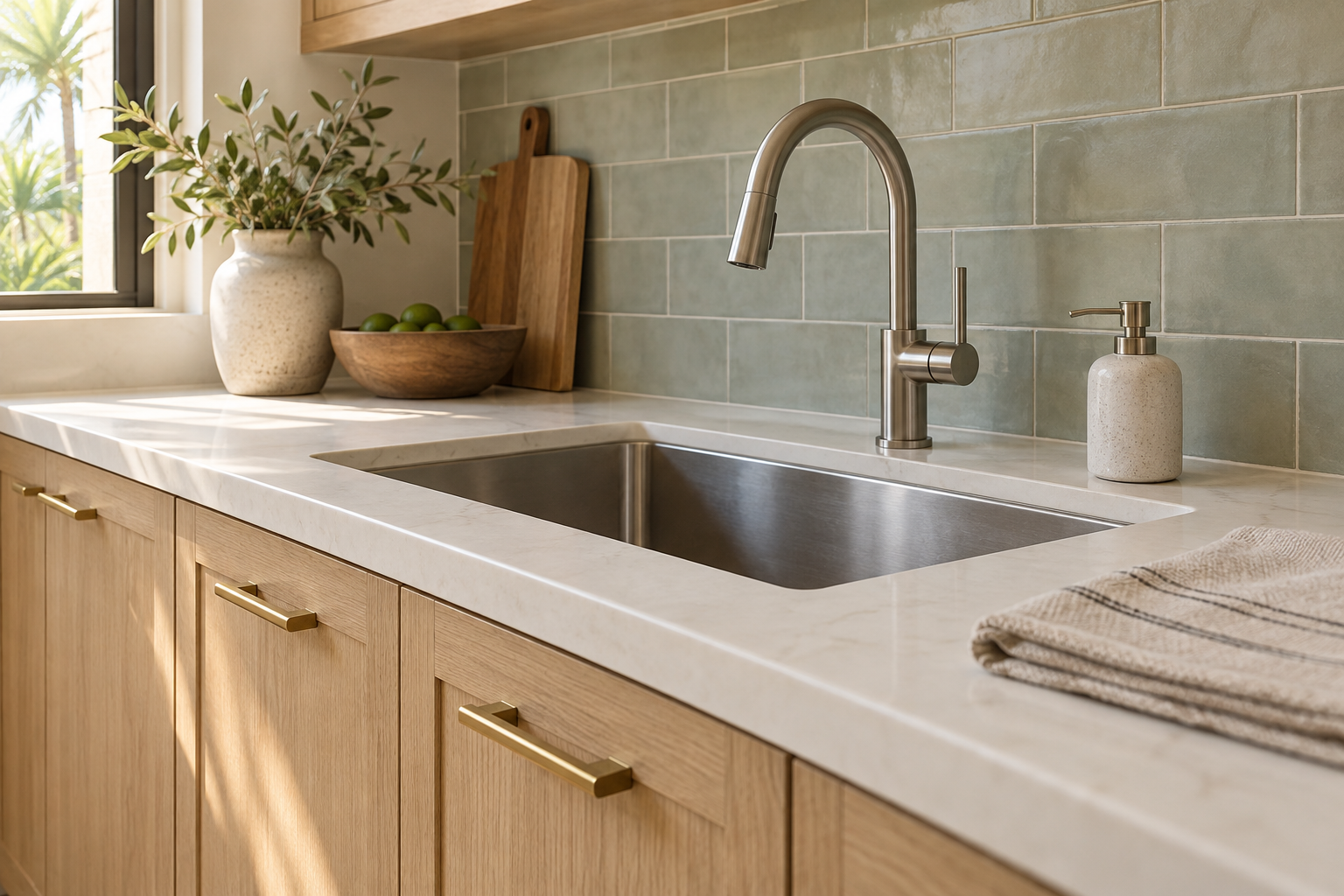
A finish name such as brass, bronze or stainless does not tell you everything about the underlying material, coating or maintenance. Compare actual samples from the manufacturers being used; identical finish names do not guarantee a match.
Test how pulls and knobs feel in the hand, confirm their dimensions and check clearances near adjacent doors. For sinks and faucets, coordinate the basin size, cabinet opening, mounting details, faucet reach, accessories and access for service. Keep the selected model numbers in the project schedule.
Ask about approved cleaners, replacement parts and warranty terms. Coastal location alone is not a reason to promise that a particular decorative finish will never corrode or discolor.
Use one selection schedule to keep the kitchen coordinated
Record decisions in a single schedule rather than relying on several sample photographs and messages. Include the following for every significant material:
- Manufacturer, product name, model or color code and finish.
- Approved physical sample or slab selection.
- Dimensions, quantities and locations.
- Edge, seam, trim and transition details.
- Installation instructions and any preparation requirements.
- Availability, delivery responsibilities and the process for substitutions.
- Cleaning, maintenance and warranty information.
Review the schedule alongside drawings and appliance specifications. Coordinate countertops with the installed cabinetry and the fabricator’s templating process. Plan flooring, cabinet and appliance sequencing according to the selected systems, not a universal order that may not fit the products.
Our pre-construction planning guide and scope and cost-control resource help turn the selections into a comparable proposal. If the project changes utilities or the room layout, coordinate those decisions before ordering finishes.
Bring the material choices into a complete remodeling plan
MDI Custom Homes is a Florida Certified Building Contractor serving Pinellas County, including Seminole, Largo and the nearby coastal communities. We approach kitchen finishes as part of the overall remodeling scope, including layout, related construction and coordination of the work.
Contact MDI Custom Homes with photographs, the property location, the parts of the room you want to keep and your priorities. For connected living spaces, review our whole-home renovation resource. For a smaller update, our cabinet upgrade guide can help you identify a more limited scope.
Kitchen material questions
Which countertop is best for low-maintenance use?
Compare the care instructions for the exact product with your cooking habits. Some engineered quartz products need no sealing but still require heat protection. Natural stone care varies with the stone and finish. No countertop is immune to every kind of damage.
Does every granite countertop need annual sealing?
No universal schedule applies. Ask the stone supplier whether the selected stone needs an impregnating treatment and what maintenance it requires. Sealing improves stain resistance; it does not make stone stain-proof.
Are solid-wood cabinets always the best choice?
Compare the whole cabinet assembly rather than one material label. Box construction, doors, panels, finish, hardware, installation and service support all matter. Ask for the specifications of each component.
Is a tile kitchen floor automatically waterproof?
No. The visible tile and grout do not establish a complete waterproof assembly. Discuss the substrate, joints, transitions and any required moisture protection with the installer.
Can different metal finishes work in one kitchen?
Yes, if the combination is deliberate and you review actual samples together. Check the function, material, finish-care requirements and replacement availability of each selected item.
When should I finalize kitchen materials?
Finalize the coordinated selections before ordering, with the layout, appliance models, installation requirements and project sequence resolved. Some final dimensions, such as countertop templates, follow the fabricator’s process after the relevant work is ready.
Bring your project into focus.
Tell MDI Custom Homes what you want to improve, what you want to keep and what matters most. We can discuss the scope and next planning steps for your Pinellas County home.
Discuss your renovation ↗Call 727-213-7309Official resources
- Natural Stone Institute: stone care and sealing
- Cambria: quartz product care
- KCMA: quality cabinet certification
- Schlüter-Systems: floor coverings and waterproofing
- NWFA: wood floor moisture and damage prevention
- TCNA: tile placement and movement joints
Use the current official guidance and project-specific requirements when planning the work.
Design imagery is illustrative and does not depict completed MDI projects or exact manufacturer products.